Weird Irish weather stats
Twenty of the oddest facts in Ireland's weather records.
Worked out from every daily reading at Met Éireann's main stations since 1942, then checked against outside sources by two separate checks. Under each one are the pages that confirm it, so you can check it too.
1,113 nights in a row without frost
Sherkin Island went 1,113 nights in a row without an air frost (a minimum below 0°C), from 10 February 2015 until the Beast from the East in 2018.
Over three years without a frost at one station, ended by the Beast from the East.
Sherkin Island sits about 2 km off Baltimore in west Cork. Met Éireann's automatic station is in the grounds of the island's marine station, and a manual climate station on the island has recorded daily rainfall and temperature since 1972.
Read more: Met Éireann · Met Éireann
- Air frost
- Night above freezing

- No. 2
16 days in a row with no sunshine
Cork Airport recorded no sunshine at all (0.0 hours) on 16 days in a row, from 23 December 2018 to 7 January 2019.
Christmas to the first week of January with no sunshine at all at Cork Airport.
Sixteen days is the joint longest run without sun at any Irish station since 1941. Cork Airport went without it from 23 December 2018 to 7 January 2019. The other was at Belmullet, Co Mayo, from 1 to 16 September 1956.
Read more: Met Éireann · RTÉ
22 Dec8 Jan- Some sunshine
- None at all
Check it: RTÉ · Cork Airport daily data (Met Éireann, CSV)
- No. 3
−8.1 °C, Christmas Day high
On Christmas Day 2010 Mount Dillon, Co Roscommon, never got above −8.1°C, while Sherkin Island in west Cork reached 6.9°C.
A 15-degree gap between Roscommon and west Cork on the same day.
On Christmas morning Straide, Co Mayo, recorded −17.5°C, the lowest December temperature ever measured in Ireland, and Casement Aerodrome's −15.7°C was the lowest in the Dublin area for any month. Casement had 27 cm of snow lying. The thaw followed: rain on the 26th and 27th, heaviest over Munster and Connacht, brought considerably milder Atlantic air.
Read more: Met Éireann
−8.1°C
Mount Dillon6.9°C
Sherkin Island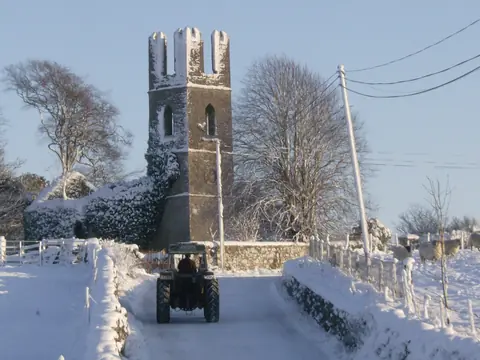
Mayo Abbey, Co Mayo, under snow on 20 December 2010, five days before Christmas.Photo: colwynboy, CC BY-SA 2.0, via Wikimedia Commons - No. 4
26 years in a row with rain on 26 December
It rained at Belmullet on St Stephen's Day 26 years in a row, 1979 to 2004 (at least 0.2 mm each time).
A wet 26 December every year for more than a quarter of a century.
Belmullet's station opened in September 1956, replacing the one at Blacksod Lighthouse, 10 miles to the south-west, run by the Sweeney family. On 3 June 1944 a Blacksod report from Maureen Flavin, then 21, warned of a storm heading for the English Channel, and Eisenhower put back D-Day by 24 hours.
Read more: Met Éireann · The Irish Times
19782005- Rain on 26 December
- Dry

Blacksod Lighthouse, Co Mayo, home of the weather station Belmullet replaced in 1956.Photo: James Emmans, CC BY-SA 2.0, via Wikimedia Commons Check it: Belmullet daily data (Met Éireann, CSV)
- No. 5
184 km/h gust
Storm Éowyn's 184 km/h gust at Mace Head on 24 January 2025 broke Ireland's record, the 182 km/h set at Foynes in 1945.
An 80-year-old record from a flying-boat base, beaten by one Atlantic gust.
ESB Networks said 768,000 customers lost power on 24 January, by far the worst storm it had dealt with. More than 138,000 people were without water too. The last homes were reconnected on 11 February, 18 days after the storm.
Anger as hundreds still without power across ConamaraRTÉ News on YouTube - No. 6
244 days in a row below 15°C
Malin Head stayed below 15°C every day for 244 days in a row, from 16 September 1974 to 17 May 1975.
Eight months without a single mild afternoon at Malin Head.
Malin Head's station records go back to 1885, and staff from Lloyd's, who ran a local coastal signal station, were the first to send regular weather reports. The present buildings went up in 1955, at the top of the Inishowen peninsula, 19 km from Carndonagh. Its highest gust, 98 knots, came on 16 September 1961, when the remains of Hurricane Debbie swept up the west coast.
Read more: Met Éireann
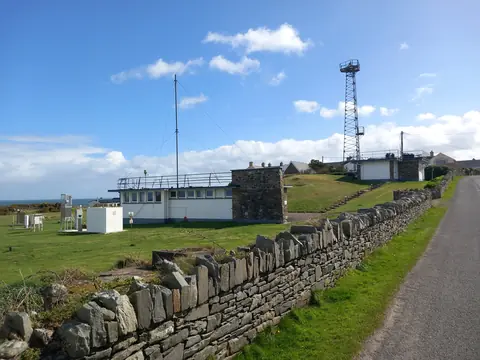
Met Éireann's weather station at Malin Head, Co Donegal, in April 2024.Photo: Darren J. Prior, CC BY 4.0, via Wikimedia Commons Check it: Malin Head daily data (Met Éireann, CSV)
- No. 7
18.1 degrees between two stations
On 26 May 2026 Shannon Airport reached 30.6°C, the highest May temperature at a Met Éireann synoptic station, while Malin Head in Donegal peaked at 12.5°C.
Summer heat at Shannon and a cool 12.5°C at Malin Head on the same afternoon.
The old May record, 28.4°C at Ardfert, Co Kerry, in 1997, fell at several climate stations on the 25th, and on the 26th Abbeyfeale and Clonmel provisionally reached 30.9°C. Met Éireann put it down to an intense high and an unseasonably hot tropical airmass. Earlier in the month Arctic air from the north had kept the country cool.
Read more: Met Éireann
12.5°C
Malin Head30.6°C
Shannon Airport - No. 8
−9.4 °C, the day's high
On 21 December 2010 the temperature at Ballyhaise, Co Cavan, never rose above −9.4°C, the coldest day ever recorded in Ireland.
A day-long freeze, not just a cold night.
The station is in the grounds of the Teagasc agricultural college at Ballyhaise, where daily readings were taken from 1932. Its December 2010 average of −1.4°C is the lowest ever measured in Ireland for any month. When the thaw came after Christmas, burst pipes left thousands of homes without water or on restrictions, and the Dublin region lost 60 million litres in one night.
Read more: Met Éireann · Met Éireann

The agricultural college at Ballyhaise, Co Cavan, whose grounds hold the weather station.Photo: -- Deadstar (msg), CC BY-SA 3.0, via Wikimedia Commons - No. 9
63 years the record stood
Dublin Airport's coldest night, −10.9°C in the Big Snow of 1947, stood for 63 years, then fell twice in two nights: −11.4°C on Christmas Eve 2010, −12.2°C on Christmas Day.
A record untouched for six decades, broken and broken again within 24 hours.
On Christmas Eve, with the first new record just set, Iarnród Éireann and Dublin Bus stopped services at 9pm and the Luas at 8pm, while fresh shipments of road salt arrived. December 2010 turned out to be the coldest of any month at Dublin Airport, in over 50 years of records.
Read more: Irish Examiner · Met Éireann
−10.9°C
Feb 1947−11.4°C
24 Dec 2010−12.2°C
25 Dec 2010
Snow in St Stephen's Green, Dublin, on 27 November 2010, early in the cold spell.Photo: William Murphy from Dublin, Ireland, CC BY-SA 2.0, via Wikimedia Commons - No. 10
43 days in a row no warmer than 5°C
In the Big Snow of 1947 Dublin Airport went 43 days in a row without rising above 5°C, from 23 January to 6 March.
Six weeks of fridge-cold days in Dublin.
The snow came on top of a fuel crisis: emergency fuel was ordered from Britain, and anyone who still had power faced a 25% electricity cut. Railway lines were blocked by 6-foot drifts. In Co Wicklow, Rathdrum residents asked the Irish Red Cross to fly food in, as many hadn't left their homes for a month.
Read more: The Irish Times
22 Jan7 Mar- High of 5°C or less
- Above 5°C
- 5°C
The oral history in Cavan Susan McCaffrey remembers the big snow of 1947cavanmuseum on YouTube - No. 11
92 days of rain in a row
Sherkin Island had rain (at least 0.2 mm) on 92 days in a row, from 9 December 2013 to 10 March 2014.
Three months without one dry day.
That was the winter of 2013/14, when storm-force winds blew on 12 different days between 5 December and 12 February, and over half of Met Éireann's stations had their wettest winter on record. On 12 February the Kinsale Energy gas platform measured a 25 m wave, its highest on record.
Read more: Met Éireann
Storm footage - Wednesday 12th FebruaryRTÉ News on YouTube - No. 12
10 days in a row dry everywhere
From 10 to 19 July 2026 none of the 24 main weather stations in our data recorded any rain (under 0.2 mm), 10 days in a row.
Ten days with no rain at any of the 24 stations.
July 2026 was the driest July on record, with 16 mm of rain across the country, 17% of normal. Uisce Éireann banned hosepipes in Dublin, south Tipperary and parts of four other counties in mid-July, then in every county from 24 July. Night-time restrictions hit 53 of the country's roughly 700 public water supplies.
Read more: Met Éireann · RTÉ
Hosepipe ban extended nationwide from Friday | RTÉ NewsRTÉ News on YouTube - No. 13
19 days in a row of rain everywhere
For 19 days in a row, 8 to 26 February 2020, every one of the 24 main weather stations in our data had rain (at least 0.2 mm).
Not one dry corner of the country for nearly three weeks.
February 2020 brought three named storms, Ciara, Dennis and Jorge, and extensive flooding, especially along the Shannon. Sixteen stations had their wettest February on record, Phoenix Park and Malin Head among them, with records going back to 1850. Claremorris and Shannon Airport got once-in-100-years amounts of rain.
Read more: Met Éireann · Met Éireann
Check it: The Irish Times
- No. 14
−0.6 °C on 30 August
Mount Dillon, Co Roscommon, had an air frost in summer: −0.6°C on 30 August 2010.
An air frost in the last days of August.
Met Éireann counts only two first frosts of autumn that came in August: this one, and −2.7°C at Rathdrum, Co Wicklow, on 30 August 1964, still Ireland's lowest August temperature. Both fell on 30 August. The station sits on Bord na Móna land north of Lanesborough, and it had the country's first autumn frost again in 2022, on 17 September.
Read more: Met Éireann · Met Éireann
- No. 15
30.5 °C at Mace Head
Mace Head, on the Connemara coast, set Ireland's gust record in January 2025, then hit 30.5°C on 25 June 2026.
A record storm gust and a 30-degree day at the same Atlantic station within 18 months.
The station is in the grounds of University of Galway's research centre near Carna, facing the open Atlantic. Aerosol measurements began nearby in 1958, at a small coastal lookout post next to the present station. Its 30.5°C was one of six all-time station records broken in June 2026, when Athenry reached 32.2°C on the 25th.
Read more: Met Éireann · universityofgalway.ie
Mace Head Atmospheric Research StationUniversity of Galway on YouTube Check it: Weather extremes (Met Éireann) · TheJournal.ie
- No. 16
31 days of rain out of 31
Cork Airport had rain (at least 0.2 mm) on every one of the 31 days of December 2015, 402.2 mm in all, three times the usual.
Not one dry day in the month, and three times the usual rain.
Met Éireann's Pat Clarke called the month exceptionally wet and mild, with two big storms, Desmond and Frank, and six weeks of moist air from the South Atlantic. Fermoy, which had seen a lot of flooding, got 324.3 mm. Daffodils came up weeks early.
Read more: The Irish Times
1 Dec31 Dec- Rain that day
- No. 17
36 days in a row at 20°C or more
Phoenix Park reached 20°C or more on 36 days in a row, 30 June to 4 August 2026, beating Shannon and Casement's 34 from 1995.
Over five weeks of summer days in Dublin without a break.
The Phoenix Park station sits in the grounds of Ordnance Survey Ireland, replacing a manual station set up in 1829. July 2026 was its warmest month on record and its driest July, in a series going back 127 years. Moore Park, Co Cork, had a 13-day heatwave that month, second only to 14 days at Birr and Ballybrittas in August 1976.
Read more: Met Éireann · Met Éireann
29 Jun5 Aug- 20°C or more
- Under 20°C
- 20°C
End of heatwave with record still unmatched | #RTÉNews #heatwave #ireland #weatherRTÉ News on YouTube - No. 18
25 days at 25°C in 71 years
Since 1955 Malin Head has reached 25°C on just 25 days and has never reached 28°C; Shannon Airport has had 300 such days in the same time.
Shannon Airport has had 12 times as many.
Its July record came on 12 July 2025: 27.6°C, the highest in 70 years of readings there, on the day Shannon Airport reached 30.6°C. What Malin Head gets instead is wind. Met Éireann says force 12 winds are recorded at the station in most years.
Read more: Met Éireann · Met Éireann
Days at 25°c or more
Malin Head From Above. Ireland's Most Northerly Point. Cinematic 4k drone video.Mark's Mavic on YouTube - No. 19
30.6 °C swing in 26 days
Casement went from −9.6°C on 2 March 1965 to 21.0°C on 28 March, a 30.6-degree swing inside one month.
A hard frost and a 21°C afternoon at the same airfield, 26 days apart.
The airfield at Baldonnel was renamed Casement Aerodrome that year, after Roger Casement, executed for his part in helping to bring about the 1916 Rising. It's now the Air Corps' base, and its weather station sends data to Met Éireann in Glasnevin.
Read more: echo.ie · military.ie
−9.6°C
2 Mar21°C
28 Mar
Casement Aerodrome at Baldonnel, south-west of Dublin, from the air in 2009.Photo: tearbringer, CC BY 2.0, via Wikimedia Commons Check it: Casement daily data (Met Éireann, CSV)
- No. 20
123 nights in a row at 10°C or more
From 20 May to 19 September 2025 the temperature on Sherkin Island never dropped below 10°C, 123 nights in a row.
Four months with no night below 10°C.
Summer 2025 was then Ireland's warmest on record, at 16.19°C, and Met Éireann credited the nights. Sea temperatures stayed high around the coast after a severe marine heatwave in May, and most stations had their highest summer average minimum on record. Summer 2026 beat it by 0.09°C.
Read more: Met Éireann · Met Éireann
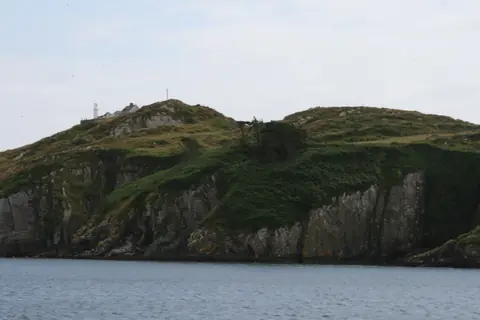
The rocky coast of Sherkin Island, off Baltimore in west Cork.Photo: Joe Stump, CC BY 2.0, via Wikimedia Commons







.jpg)
.jpg)
.jpg)

.jpg)


More
Ask your own question on the Irish weather page: every streak, every season.
More weird stats: Formula 1, Premier League and GAA.